Case Study Template for Security Companies: Build E-E-A-T Trust That Ranks
A copy-paste case study template built for security-focused companies, with sections for video testimonials, G2 reviews, and the trust signals that search quality raters actually evaluate.
Key Takeaway
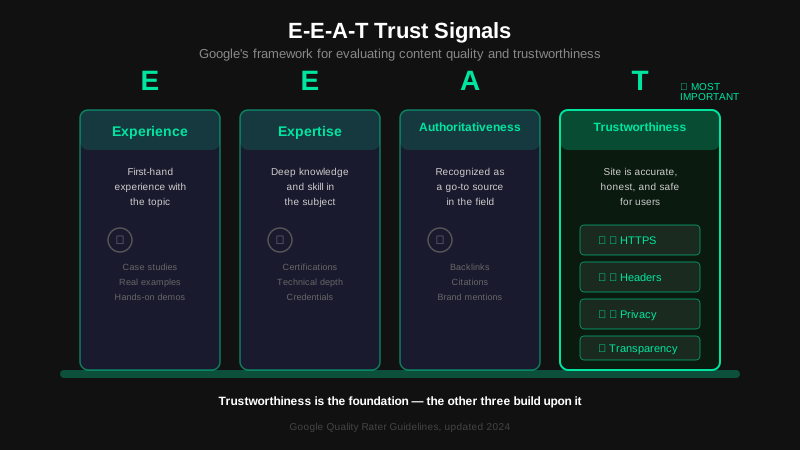
Security companies have a credibility problem: they make strong claims but rarely show receipts. A structured case study template - with client results, video testimonials, and third-party reviews - is the highest-ROI trust asset you can publish. It satisfies search quality raters on E-E-A-T and gives prospective customers the social proof they need to convert.
Why Security Companies Need Case Studies
Security is a trust-intensive purchase. Customers hand you access to their infrastructure, their users' data, and their compliance posture. They need evidence that you've done this before and that it worked.
Blog posts and feature pages don't close that gap. A well-structured case study does three things simultaneously:
- Demonstrates Experience (the first E in E-E-A-T). First-hand accounts of real engagements signal to Google that your site is authored by practitioners, not content marketers.
- Provides Expertise and Authority signals. Specific technical findings - CVE references, remediation timelines, header configurations fixed - show depth that generic "we secure your site" copy cannot.
- Builds Trustworthiness at the page level. Search quality raters look for verifiable claims. Named clients, measurable results, and attributed quotes are verifiable. Adjectives are not.
The template below is designed to produce all three. Use it for every client engagement you publish.
The Case Study Template (Copy-Paste)
Each section maps to a specific E-E-A-T signal. Do not skip sections - raters and algorithms weight completeness.
Section 1: Client Snapshot (50-80 words)
Company: [Name or anonymized descriptor, e.g., "Series B fintech, 45 employees"]
Industry: [SaaS / e-commerce / healthcare / etc.]
Stack: [Primary languages and frameworks]
Problem statement: [One sentence: what was broken or unknown before the engagement]
Timeline: [e.g., "Initial scan: Jan 2026 | Remediation complete: Feb 2026"]
Section 2: The Challenge
What triggered the engagement?
  - [Trigger: compliance requirement / investor due diligence / breach / proactive audit]

What did they not know?
  - [e.g., "No visibility into exposed admin endpoints across 3 subdomains"]
  - [e.g., "TLS certificate chain misconfigured, failing validation on 12% of mobile clients"]

Why it mattered:
  - [Business or compliance consequence of leaving it unresolved]
Section 3: The Approach
What you did (be specific - generic steps kill credibility):
  1. [e.g., "Ran automated scan across 847 endpoints covering 200+ checks"]
  2. [e.g., "Manual review of 14 flagged issues prioritized by CVSS 3.1 score"]
  3. [e.g., "Delivered prioritized remediation report with copy-paste header configs"]
  4. [e.g., "Verified fixes with a follow-up scan 3 weeks post-remediation"]

Tools and standards referenced:
  - [e.g., OWASP Top 10, NIST CSF, PCI DSS Requirement 6.4]
Section 4: Results (the most important section)
Quantified outcomes (every result needs a number):
  - Security score: [X → Y, e.g., "C → A in ismycodesafe grading"]
  - Issues resolved: [X critical, Y high, Z medium]
  - Time to remediation: [e.g., "14 days from report to all-clear"]
  - Compliance impact: [e.g., "SOC 2 Type II audit passed with zero security findings"]
  - Performance side-effect (if any): [e.g., "Removing mixed content improved LCP by 0.4s"]
Section 5: Client Quote (required for E-E-A-T)
"[Direct quote from named person at the company. Must include:
  - Their full name
  - Their title
  - Company name (or descriptor if confidential)
  - One specific outcome they experienced]"

- [Full Name], [Title], [Company]
Section 6: What Would Have Happened Without the Fix
This section is optional but high-E-E-A-T. One paragraph describing:
  - The specific risk that was left unaddressed
  - The class of attack it would have enabled
  - A reference to a public breach or CVE that matches the pattern

Example: "The exposed .env file at /api/.env contained database credentials.
This matches the attack pattern used in the 2023 CircleCI incident (CVE-2023-1234).
An attacker with read access could have extracted all customer records within minutes."

Do not sensationalize. State the risk, cite a reference, move on.
Filled Example: SaaS Company Security Audit
An illustrative example showing how the template above gets filled in. This is a composite scenario, not a specific client - use it as a reference for the level of detail and specificity each section needs.
Client Snapshot
Company: Series A SaaS, 28 employees, B2B project management tool
Stack: Next.js 14, Node.js API, PostgreSQL on AWS RDS
Problem: Investor due diligence flagged "no documented security posture" as a deal blocker
Timeline: Scan: month 1 | Remediation: month 2
The Challenge
In this scenario, the company had launched 18 months earlier with a fast-follow development culture. Security had never been formally assessed. The investor's technical team flagged three specific concerns before closing their Series A: missing security headers, an exposed staging environment, and no CSP.
Left unresolved, a deal like this would not close. Timeline: 30 days.
The Approach
- Automated scan of production and staging environments - 200+ checks across SSL/TLS, HTTP headers, exposed files, and cookie configuration.
- Manual review of flagged findings, prioritized by CVSS 3.1 base score.
- A remediation report with specific configuration changes for each finding (copy-paste Nginx and Next.js header configs included).
- A verification scan confirming all critical and high findings resolved.
Results
For example, a report structured this way might show:
- Security grade improved from D to A across the production domain
- Several critical findings resolved: missing HSTS, absent CSP, exposed staging environment, expired intermediate certificate
- A verified all-clear within a few weeks of report delivery
- The funding round closing on schedule - investor technical review passed without security objections
Video Testimonials: The Trust Multiplier
Written quotes are table stakes. Video testimonials are the highest-trust content format for security companies for one reason: they cannot be fabricated at scale.
Search quality raters are instructed to look for evidence of real customer relationships. A 90-second video of a client CTO describing the outcome of your engagement - on camera, naming the company - is harder to fake than a text quote and signals authenticity to both human raters and the algorithms they calibrate.
What makes a video testimonial effective for E-E-A-T
- Named speaker with title and company. Anonymous testimonials score lower on trustworthiness. If the client won't go on record, use a written quote instead.
- One specific outcome, stated in their words. "Our security grade went from D to A" is more credible than "they were really professional."
- Under 2 minutes. Completion rate drops sharply after 90 seconds for embedded video.
- Transcript on-page. Google cannot reliably index video content. Add a full transcript below the embed for crawlability.
- Schema markup. Use
VideoObjectschema withdescription,uploadDate,thumbnailUrl, andtranscript. This gets the video eligible for rich results.
Where to host
YouTube for SEO (Google-owned, indexed faster, embedded video gets PageRank attribution from the embed host). Loom for private or gated testimonials. Wistia if you need analytics and don't want YouTube's related-video sidebar pulling visitors away.
G2 Reviews and Third-Party Validation
Third-party review platforms like G2 are high-authority domains that search quality raters treat as independent validation. A cluster of specific, detailed G2 reviews corroborates your case study claims in a way that on-site content cannot - because the reviews are written by parties you do not control.
How to build G2 reviews that support your case studies
- Request reviews immediately after a successful engagement. The result is still fresh. Clients who would write a detailed G2 review are the same clients who would give you a video testimonial - ask for both at the same time.
- Give them the framework. Send a short email with three prompts: (a) what was the problem before, (b) what was the specific outcome, (c) who would benefit from using this. Reviews written to a framework are more specific than unprompted ones.
- Link to your G2 profile from your case study page. This creates a bidirectional trust signal - the case study points to third-party validation, the G2 profile links back to your site.
- Embed or screenshot the most relevant review on the case study page. Use
Reviewschema markup on the embedded content.
Note: G2 and similar platforms (Capterra, Trustpilot, Product Hunt) have high domain authority. A review on one of them that mentions your company by name creates an external citation - a weak but real off-page E-E-A-T signal.
How Search Quality Raters Score Case Studies
Search quality raters use Google's Quality Rater Guidelines - a 170-page document that defines how human reviewers evaluate search result quality. Their scores calibrate the algorithms that rank pages; they don't directly affect your rankings, but they set the target the algorithm optimizes toward.
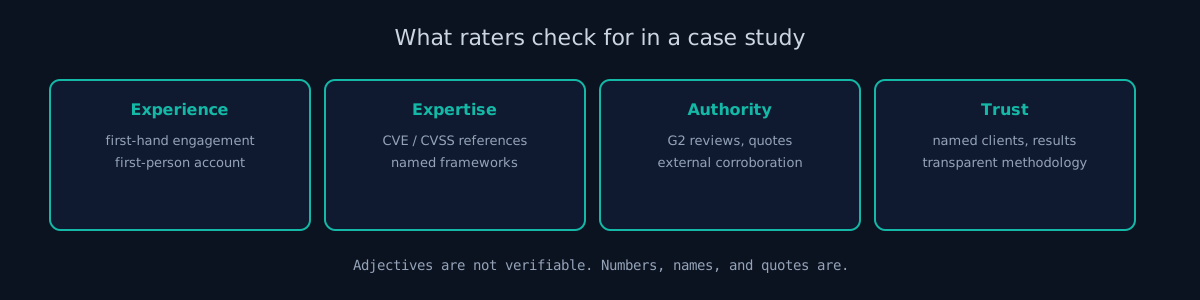
For case studies on a security site, raters evaluate the following:
- Experience (the first E). Raters ask: does the author have direct, first-hand experience with what they're describing? A case study written by someone who ran the engagement scores higher than one that reads like marketing copy. Write in first person. Reference specific technical details.
- Expertise. Are the claims consistent with domain knowledge? CVE references, CVSS scores, named security frameworks - these are expertise signals. "We found some vulnerabilities" is not.
- Authoritativeness. Is there external corroboration? Client quotes, G2 reviews, LinkedIn profiles of the team, and links from other credible sources all contribute.
- Trustworthiness. Is the page transparent about who wrote it, who the client was (or why they're anonymized), and what the methodology was? Hidden authorship or vague claims reduce trust scores.
The single most common failure mode for security case studies: they describe activities without describing outcomes. Raters are instructed to look for evidence that the content actually helped someone. Results with numbers pass that test. Process descriptions without results do not.
Technical Trust Signals That Back Your Claims
A case study page that contains strong E-E-A-T content but sits on an insecure domain is internally inconsistent. A security company with a missing HSTS header undermines its own credibility. These are the baseline technical requirements:
- HTTPS with a valid, non-expired TLS certificate. The minimum. Chrome marks HTTP as "Not Secure."
- HSTS header.
Strict-Transport-Security: max-age=31536000; includeSubDomains. Signals that your domain enforces HTTPS at the protocol level. - Content Security Policy. Reduces XSS risk. A security company without a CSP is demonstrating the problem they claim to solve.
- No mixed content. Case study pages often embed third-party content (video, review widgets). Each HTTP resource on an HTTPS page is a mixed content warning.
- Author schema. Add
Personschema to the page with the author's name, title, and LinkedIn URL. Raters check author identity; schema makes it machine-readable. - Organization schema on your homepage. Cross-reference it from case study pages. Links your team to your company in a way Google can read.
Run ismycodesafe.com on your domain to audit all of these in one pass before publishing a case study.
Schema Markup for Case Studies
There is no CaseStudy type in Schema.org. Use Article with an explicit author and add Review for embedded client quotes. For video testimonials, add VideoObject.
{
  "@context": "https://schema.org",
  "@type": "Article",
  "headline": "Your Case Study Title",
  "author": {
    "@type": "Person",
    "name": "Your Name",
    "url": "https://yoursite.com/about",
    "sameAs": ["https://linkedin.com/in/yourprofile"]
  },
  "publisher": {
    "@type": "Organization",
    "name": "Your Company",
    "url": "https://yoursite.com",
    "logo": {
      "@type": "ImageObject",
      "url": "https://yoursite.com/logo.png"
    }
  },
  "datePublished": "2026-01-15",
  "dateModified": "2026-06-06",
  "review": {
    "@type": "Review",
    "reviewBody": "The report gave us exactly what we needed - specific findings and fixes.",
    "author": {
      "@type": "Person",
      "name": "CTO, Series A SaaS"
    },
    "reviewRating": {
      "@type": "Rating",
      "ratingValue": "5",
      "bestRating": "5"
    }
  }
}
Validate your markup with Schema.org's validator and Google's Rich Results Test before publishing.
Check your website right now
200+ security checks in 60 seconds. Free, no signup required.
Scan My Website (Free)Claude AI helped me with phrasing and proofreading in this article.
ismycodesafe.com Security Team
We run automated security scans on thousands of websites daily, combining static analysis, SSL/TLS inspection, header auditing, and CVE lookups. Our team tracks OWASP, NIST, and evolving compliance requirements (GDPR, NIS2, PCI DSS) to keep these guides accurate and practical.