NIST 800-53 for Web Apps: Controls, Compliance Program and Audit
Most web applications get security wrong in the same two ways: they skip the documentation, and they treat compliance as a one-time checkbox. NIST 800-53 solves both. Here is how to use it.
Key Takeaway
NIST 800-53 is the US federal risk management framework, organized into 20 control families. For most web applications, a compliance program built on the Moderate baseline requires three documents (information security policy, acceptable use policy, incident response plan), a readiness assessment against current posture, and a repeating compliance audit cycle. The controls themselves are covered in our dedicated NIST 800-53 controls guide.
What Is Web Security Compliance?
Web security compliance means operating your web application in a way that satisfies a defined security standard. The standard could be legal (GDPR, NIS2), contractual (PCI DSS, customer security questionnaires), or voluntary (NIST 800-53, ISO 27001, SOC 2). Most organizations end up dealing with more than one.
The word "compliance" gets used in two ways that are worth keeping separate. There is compliance-as-checkbox: you implement the minimum controls required to pass an audit. And there is compliance-as-practice: you build a security program with ongoing processes, documentation, and review cycles. The first gets you through the audit once. The second keeps you out of trouble between audits.
For web applications specifically, the practical definition is simpler. Can you demonstrate, to a third party, that you know what assets you have, what threats exist, what controls you have in place, and what you do when something goes wrong? If yes, you have a compliance posture. If not, you have a gap.
NIST 800-53 as Your Risk Management Framework
NIST Special Publication 800-53 is the most complete publicly available risk management framework for information systems. It was built for US federal agencies under FISMA, but private companies adopt it because the control catalog is thorough and well-documented. The full text is free at csrc.nist.gov.
Revision 5 (2020) organizes the controls into 20 families. For a web application, you are not implementing all of them. Physical and environmental controls (PE family) apply to your cloud provider, not your application. Personnel security (PS) applies at the organization level. What remains for a web app is about six families - SC, IA, SI, AU, SA, and CM - covering encryption, authentication, vulnerability management, logging, secure development, and configuration.
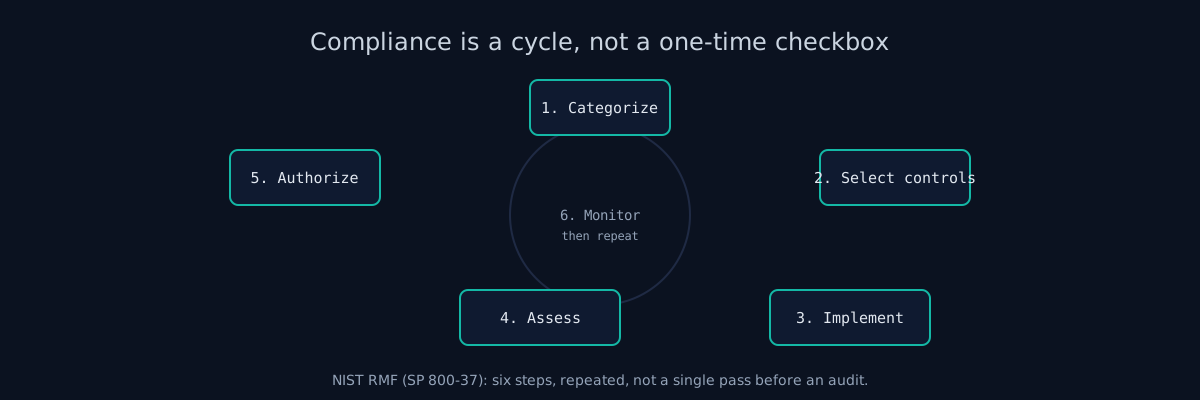
The risk management framework that NIST 800-53 sits inside (formally the NIST RMF, SP 800-37) has six steps: categorize, select, implement, assess, authorize, and monitor. In practice for web applications, this translates to: identify what you have, pick controls appropriate to your risk level, implement them, test that they work, get sign-off that the risk is acceptable, and keep checking. The framework is the cycle, not a one-time event.
The control families that touch a web application
NIST SP 800-53 Revision 5 groups its controls into 20 families: AC, AT, AU, CA, CM, CP, IA, IR, MA, MP, PE, PL, PM, PS, PT, RA, SA, SC, SI and SR. The full catalog and the baselines in SP 800-53B are free at csrc.nist.gov.
For a team shipping a web app or an API, six families carry most of the engineering work:
| Family | What it asks for in a web app |
|---|---|
| SC, System and Communications Protection | TLS everywhere, HSTS, encryption of stored secrets, boundary protection |
| IA, Identification and Authentication | MFA for admins, password storage with a slow hash, service account identity |
| SI, System and Information Integrity | Vulnerability scanning, patching dependencies, input validation |
| AU, Audit and Accountability | Logs of auth events and admin actions, kept long enough to investigate |
| SA, System and Services Acquisition | A secure development process, including review of third-party code |
| CM, Configuration Management | Hardened defaults, an inventory of what runs where, no stray services |
The rest still applies to the organization. Physical protection, personnel screening and training sit with people other than the developer.
What an outside scan can actually prove
An auditor asks for evidence per control. A website scanner can supply a small piece of it, for a handful of controls, and nothing for the policy and process work that makes up most of a compliance program. The table shows how often that small piece comes back as a failure.
The numbers are from 933 sites in a May 2026 research scan (internal data from ismycodesafe). We attempted 2,211 and kept responses with readable headers that our filter didn't flag as bot-protection or error pages (method and caveats). The control column is our closest mapping, not an official NIST crosswalk.
| Closest control | What the scan sees from outside | Sites that failed it |
|---|---|---|
| SC-8, Transmission Confidentiality and Integrity | No Strict-Transport-Security header | 557 of 933 |
| SC-18, Mobile Code | No Content-Security-Policy that restricts scripts | 855 of 933 |
| CM-6, Configuration Settings | X-Powered-By header announces the framework | 137 of 933 |
The middle row needs a note. 191 of the 933 did send a Content-Security-Policy, but 113 of those policies only set things like frame-ancestors or upgrade-insecure-requests and say nothing about scripts. SC-18 is about controlling code that runs in the browser, so those headers are not evidence for it.
Scan output is a dated observation of the public surface. Attach it with the date.
Your Information Security Policy
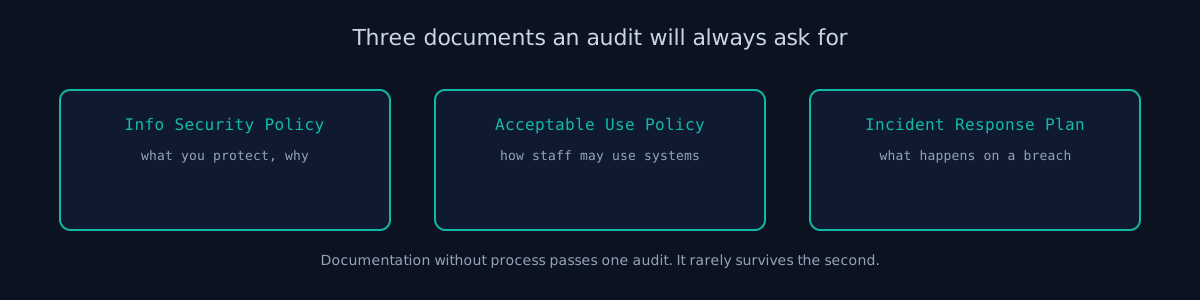
Every NIST 800-53 audit starts with documentation review. If you do not have a written information security policy, the auditor marks that as a finding before examining any technical control. PL-1 (Planning Policy and Procedures) requires a documented policy covering purpose, scope, roles, responsibilities, and compliance.
A functional information security policy for a web application covers five areas. Who is responsible for security decisions (the CISO, the founder, the lead engineer - whoever owns it, name them). What data you hold and how it is classified (public, internal, confidential, restricted). How access is granted, reviewed, and revoked. What happens when a security event is detected. And how the policy is reviewed and updated.
The policy does not need to be long. A three-page document that is actually followed beats a 40-page document that nobody reads. The test is whether a new engineer joining the team can read it and know what they are and are not allowed to do with your systems and data.
NIST 800-53 control PL-4 adds a system rules-of-behavior requirement - essentially a signed acknowledgment from users that they have read and understood the security rules. For internal teams this is typically covered by an onboarding process. For SaaS products with end users, the terms of service serves a similar function.
The Acceptable Use Policy
The acceptable use policy (AUP) sits alongside the information security policy and covers a narrower question: what are users permitted to do with company systems, data, and infrastructure?
For a web application company, the AUP typically covers three groups. Employees and contractors: acceptable use of company devices, systems, and SaaS tools. Administrators: what is permitted when accessing production environments, customer data, or security-sensitive configuration. End users of the product: what constitutes acceptable use of the service itself (covered in your terms of service, though internally the policy language is often sharper).
The NIST 800-53 control that requires this is PL-4. Auditors look for evidence that staff have read and acknowledged the AUP - typically a signed document at onboarding or an annual re-acknowledgment process. Without this, you have a PL-4 finding in every audit.
The content matters less than you might think. Three things the policy must clearly prohibit: using company systems to access or process data in ways not required for the job, sharing credentials between users (each person needs their own account for AU controls to work), and circumventing security controls like MFA or VPN access.
Building a Compliance Program
A compliance program is the ongoing operation, not the one-time setup. The difference between having controls and having a program is that a program has owners, schedules, and evidence.
Three things define a functional compliance program. First, someone owns it. This does not require a full-time compliance officer at an early-stage company. It requires a named individual who is accountable for the program and whose performance is evaluated partly on compliance outcomes. Second, the program runs on a schedule. Quarterly vulnerability scans, annual policy reviews, semi-annual access reviews - these are not done when someone remembers but when the calendar says so. Third, evidence is collected. An auditor cannot take your word for it that scans happened. They need logs, reports, tickets, and sign-offs.
For a small SaaS team, a minimal compliance program has four components: a policy set (information security policy, AUP, incident response plan), a risk register (what you are worried about and what you are doing about it), a vulnerability management process (scans, CVE tracking, patch timelines), and an access review cycle (who has access to what, reviewed on a schedule).
That is enough to pass a first audit at a mid-market enterprise. It is not enough for FedRAMP or DISA IL. Scale the program to match the compliance target, not to some theoretical maximum.
The Compliance Audit Process
A compliance audit is a formal assessment of whether your controls match the standard you are claiming to meet. The process has three phases regardless of which framework is being audited.
The first phase is evidence collection. The auditor sends a request list covering policies, system configurations, scan reports, access logs, and change management records. This is where teams without a compliance program panic. If you have been maintaining documentation as a continuous practice, this is three to five days of organized evidence gathering. If not, it is three to five weeks of retroactive reconstruction - and some gaps cannot be papered over.
The second phase is testing. For NIST 800-53, this typically includes control interviews (walk me through how you handle a new employee getting access to production), configuration review (show me the TLS settings on your load balancer), and vulnerability scan results review. The auditor is not just checking that controls exist - they are checking that controls work as described.
The third phase is findings and remediation. Every audit produces findings. The question is whether findings are high-severity (control is completely absent), medium (control exists but has gaps), or low (documentation is incomplete but the control functions correctly). High-severity findings block certification or generate a Plan of Action and Milestones (POA&M) requiring remediation within a defined window.
Compliance Readiness Assessment
A readiness assessment is what you do before an audit. It answers: if the auditor walked in today, what would they find?
The output of a readiness assessment is a gap list sorted by severity. Each gap maps to a specific control, has a current state description, a target state, and an owner. This is not a theoretical exercise - you are producing exactly the evidence collection you will need for the real audit, which means the assessment itself generates compliance artifacts.
For web applications, a readiness assessment starts with three technical checks that surface the most common gaps. Run an automated scan against your production environment - this catches SC-8 (TLS configuration), CM-7 (exposed ports and unnecessary services), and SI-11 (error handling exposing internals). Review your access control list for production systems - this surfaces IA-2 failures (missing MFA) and AC-2 gaps (accounts with no business owner). Pull your last 90 days of security event logs - this shows whether AU-2 (auditable events) and AU-3 (log content) controls are functioning.
The documentation check runs in parallel. Do you have a written information security policy? An AUP? An incident response plan? If any of these are missing, that is a finding before the technical controls even come into scope.
ismycodesafe.com runs 200+ automated checks against your production URL and maps findings to the control families that apply to web applications. It does not replace a full readiness assessment - that requires document review and interviews - but it covers the SC, IA, CM, and SI technical surface in one pass.
Compliance Management: Staying Compliant
Compliance is not a state you achieve once. It is an ongoing process because systems change, threats change, and frameworks get updated. NIST 800-53 Rev 5 was published in 2020. There will be a Revision 6. The controls you implemented for Rev 5 may need updates.
Ongoing compliance management has three operational rhythms. Monthly: review security scan results, track open findings, verify that no new high-severity issues have been introduced by recent deployments. Quarterly: access review (who can still access what and why), patch review (are open CVEs within their remediation window), and policy check (has anything changed that requires a policy update). Annually: full policy review and re-approval, risk register update, third-party vendor review.
The most common compliance management failure is not a dramatic breach. It is configuration drift. A certificate gets renewed but the cipher suite baseline gets loosened in the process. A new engineer gets production access for an incident and the access is never revoked. A third-party library with a known CVE stays in the dependency tree for eight months because nobody assigned the patch. These gaps compound quietly until they are all present simultaneously when an auditor shows up.
Automated scanning on a weekly or monthly schedule catches most configuration drift before it becomes an audit finding. Track the delta between runs - a new port exposed, a header dropped, a certificate about to expire - and you have a continuous monitoring process that satisfies NIST 800-53 CA-7 (Continuous Monitoring) without building a full security operations center.
NIST 800-53 next to NIS2 Article 21
NIS2 (Directive (EU) 2022/2555) does not reference NIST. Its Article 21(2) lists ten areas of risk-management measures, and each lands in one or two 800-53 families. If you already run a program on 800-53, this is the shortest path to answering a NIS2 question.
| NIS2 Art. 21(2) | Measure | Nearest 800-53 families |
|---|---|---|
| (a) | Risk analysis and information system security policies | RA, PL, PM |
| (b) | Incident handling | IR |
| (c) | Business continuity, backups, disaster recovery, crisis management | CP |
| (d) | Supply chain security | SR |
| (e) | Security in acquisition, development and maintenance, including vulnerability handling and disclosure | SA, SI, RA-5 |
| (f) | Assessing whether the measures work | CA |
| (g) | Cyber hygiene and training | AT |
| (h) | Cryptography and encryption | SC-12, SC-13 |
| (i) | HR security, access control, asset management | PS, AC, CM-8 |
| (j) | MFA or continuous authentication, secured communications | IA-2, SC-8 |
The transposition deadline was 17 October 2024 (Article 41), and several member states were late. Reporting duties and which entities are in scope come from the national law, so check the one that applies to you.
Check your website right now
200+ security checks in 60 seconds. Free, no signup required.
Scan My Website (Free)Claude AI helped me with phrasing and proofreading in this article.
Roy Morken
I build ismycodesafe.com, the scanner these guides are written around. I'm an indie security practitioner based in Norway, and I write about the checks the scanner runs and how to fix what they find. Questions or corrections: help@ismycodesafe.com.