GDPR for Developers Practical Guide: Differential Privacy, Consent, and Data Protection
This practical guide covers everything a developer is directly responsible for under GDPR: lawful basis for processing, consent implementation, data subject rights endpoints (Articles 15-22), encryption at rest and in transit, differential privacy for analytics, and the 72-hour breach notification window.
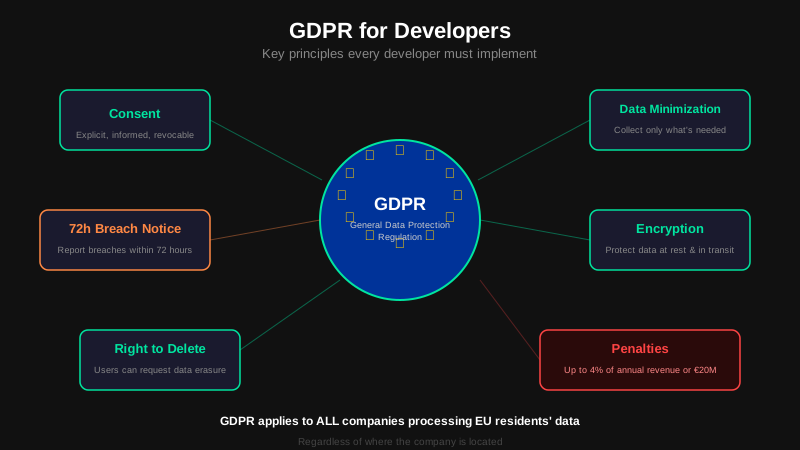
Key Takeaway
GDPR practical guide for developers: implement lawful consent (no pre-checked boxes), build data subject rights endpoints (access, erasure, portability), encrypt sensitive fields at rest, apply differential privacy to published analytics (epsilon below 1.0 for Article 9 categories), and have a tested breach response plan that can hit the 72-hour notification window.
GDPR: What Developers Are Actually Responsible For
Most GDPR guides are written for legal teams. This is a practical guide for developers - the people who build the forms, APIs, databases, and pipelines that actually process personal data. As a developer, GDPR puts specific obligations on the code you write: how you collect consent, which endpoints you expose, how you store passwords, and what happens when a breach occurs.
The six areas where developer decisions directly affect GDPR compliance:
- Lawful basis and consent: no tracking script loads before the consent event fires; no pre-checked boxes; separate toggles per purpose category
- Data subject rights: Articles 15-22 require specific endpoints - access export, rectification, erasure, portability, restriction
- Encryption: TLS 1.2+ in transit; application-level encryption for sensitive fields at rest; Argon2/bcrypt for passwords
- Differential privacy: the Article 25 (privacy by design) compliant approach to analytics - adds calibrated noise so aggregates are useful but individuals cannot be reconstructed
- Data minimization: collect only what you need; enforce retention limits in queries, not just policy documents
- Breach response: 72-hour notification window from discovery; you cannot hit it without logging, alerting, and a documented incident response plan already in place
The rest of this practical guide covers each area with code-level specifics. Start with consent and data subject rights - regulators scrutinize those first.
What Is Differential Privacy?
Differential privacy (DP) is a mathematical guarantee about what query outputs reveal. The definition: for any two datasets that differ by exactly one record, the probability of any given output is nearly identical regardless of which dataset was queried. An attacker cannot tell whether your record was included.
Apple applies local DP to collect iPhone usage stats without transmitting raw data to its servers. The US Census Bureau applied central DP to 2020 decennial data before publication. Both cases involve the same tradeoff: inject noise to protect individuals, accept slightly reduced accuracy in aggregate statistics.
For GDPR purposes, differentially private outputs are substantially harder to classify as "personal data" under Article 4(1), because no individual can be singled out from the result. That does not eliminate obligations on the underlying raw data, but it changes what you can publish, share downstream, or retain past a user's deletion request.
Local vs. Central Differential Privacy
Two deployment models, two different trust assumptions:
- Local differential privacy (LDP): noise is added on the user's device before any data leaves. The server never receives raw input. Even a compromised server learns nothing about individual records. The cost: local noise compounds across users, so you need roughly 10 to 100 times more data than central DP to get statistically useful aggregates.
- Central differential privacy: raw data is collected by a trusted curator, aggregated, and noise is added to the output before it leaves the system. More statistically efficient per query. If the raw store is breached, individual records are exposed, so access controls on the raw data matter.
Most web apps end up using both: LDP for telemetry events that should never touch a server in raw form, central DP for internal dashboards and reports where accuracy is important and the database is properly access-controlled.
The Privacy Budget: Epsilon
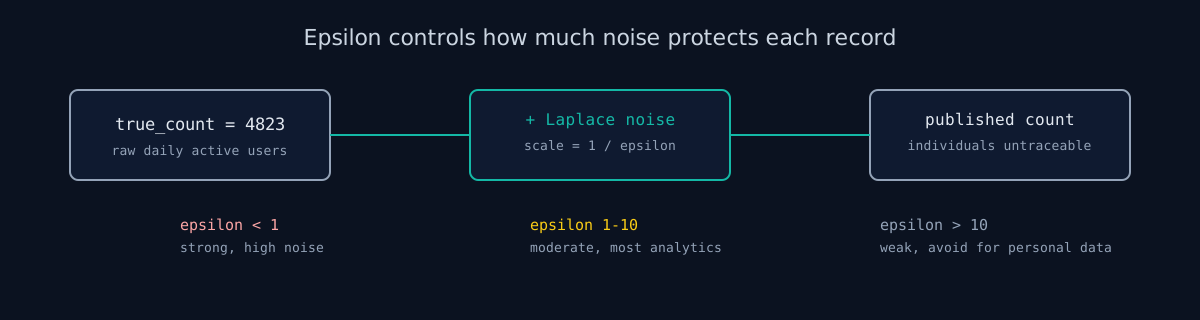
Epsilon (ε) quantifies privacy loss. Lower epsilon means more noise and a stronger guarantee. Formally: for any two neighboring datasets, the probability ratio of any output is bounded by exp(ε). In practice, what this means for query design:
- ε < 1: strong guarantee. Required for GDPR Article 9 sensitive categories (health data, biometric data, political opinion). At this range, noise is significant and useful only for high-volume aggregates.
- 1 ≤ ε ≤ 10: moderate. Reasonable for most analytics - page view counts, session durations, feature adoption rates. Practical accuracy for datasets above a few thousand records.
- ε > 10: weak. A formal DP guarantee still exists, but the practical protection against re-identification is marginal. Avoid for anything touching personal data.
Epsilon is a budget you spend. Ten queries each at ε=1.0 total ε=10.0 over the dataset. Track it. Once exhausted, you either stop querying, increase noise per query, or accept a weaker aggregate guarantee. Libraries like OpenDP and Google's differential-privacy handle budget accounting automatically.
Implementing Differential Privacy
Two mechanisms cover most web app use cases.
Laplace mechanism for numeric queries (counts, sums, averages). Adds noise drawn from a Laplace distribution scaled to sensitivity divided by epsilon. Sensitivity is the maximum change one record can cause in the query output - for a simple count, that is 1:
import numpy as np

def dp_count(true_count: int, sensitivity: float, epsilon: float) -> float:
    """
    Differentially private count using the Laplace mechanism.
    sensitivity=1 for count queries (one record changes count by at most 1).
    """
    noise_scale = sensitivity / epsilon
    noise = np.random.laplace(0, noise_scale)
    return max(0.0, true_count + noise)  # clamp to non-negative

# Example: daily active users with epsilon=1.0
private_dau = dp_count(true_count=4823, sensitivity=1, epsilon=1.0)
# Expected absolute error: ~1.41 (sqrt(2) / epsilon)
# At epsilon=0.5: ~2.83. At epsilon=2.0: ~0.71.
Randomized response for boolean attributes - the standard LDP approach. Each user answers a yes/no question honestly with probability that scales with epsilon, randomly otherwise. The server estimates population proportions via calibration:
import random
import numpy as np

def randomized_response(true_answer: bool, epsilon: float) -> bool:
    """
    Local DP for boolean questions (LDP).
    epsilon=1.0 -> user answers honestly ~73% of the time.
    epsilon=2.0 -> ~88%. epsilon=0.5 -> ~62%.
    """
    p_honest = np.exp(epsilon) / (1 + np.exp(epsilon))
    if random.random() < p_honest:
        return true_answer
    return random.random() < 0.5

def estimate_true_proportion(reported: list[bool], epsilon: float) -> float:
    """Calibrate noisy responses back to an estimated true proportion."""
    p_honest = np.exp(epsilon) / (1 + np.exp(epsilon))
    observed = sum(reported) / len(reported)
    return (observed - 0.5) / (p_honest - 0.5)
For production, use an audited library rather than the above directly. OpenDP (Python/Rust, formally verified) and Google's differential-privacy library (Java/Go/C++) are the two most production-ready options. Both include budget tracking and composition theorems.
Differential Privacy and GDPR
GDPR Article 25 requires "data protection by design and by default." The European Data Protection Board and the UK ICO have both cited statistical noise injection as a technically valid privacy-by-design measure in their anonymization guidance. Differential privacy, specifically, meets that technical threshold because it offers a provable mathematical bound rather than a heuristic one.
Article 89 creates a second opening: processing for research or statistical purposes can qualify for reduced restrictions, provided "appropriate safeguards" are in place. The recitals identify pseudonymization as one such safeguard. Documented DP with tracked epsilon clears that bar.
Three practical results:
- DP outputs can be published or shared with third parties where raw data cannot
- Retention periods for DP outputs are less constrained than raw personal data under Article 5(1)(e)
- Article 17 (right to erasure) applies to the raw records, not necessarily to derived DP statistics that cannot be reversed
What DP does not fix: consent requirements still apply at collection, breach notification timelines still run from discovery, data subject rights still cover the raw store, and cross-border transfer restrictions under Chapter V still apply. DP changes what you can do downstream, not what you owe upstream.
Consent Management
Even with differential privacy applied to outputs, you need a lawful basis to collect input data. For analytics and marketing cookies that basis is consent under Article 6(1)(a). Requirements for valid consent:
- Freely given - no "accept all or leave" dark patterns
- Specific - separate toggles for analytics, marketing, functional cookies
- Informed - explain what data you collect, how long you keep it, and who processes it
- Pre-checked boxes are illegal - opt-in only, never opt-out
- No tracking scripts load before consent fires
Withdrawing consent must be as easy as giving it. Store consent timestamps and the exact version of the consent text shown. You will need this in a regulator investigation.
Data Subject Rights: Building the Endpoints
Articles 15-22 of GDPR give individuals eight rights over their personal data. As a developer, you are the person who builds the endpoints that make those rights real. Regulators check these first because they are observable - a user can click a button and see if the system works.
| Article | Right | What to build | Deadline |
|---|---|---|---|
| 15 | Right of access | GET /api/user/data-export - returns all personal data held about the user in JSON or CSV | 30 days |
| 16 | Right to rectification | PATCH /api/user/profile - authenticated update for any personal field | 30 days |
| 17 | Right to erasure | DELETE /api/user/account - hard delete of personal data across all tables; cascade to logs | 30 days |
| 18 | Right to restriction | Flag on the user record: processing_restricted = true; check flag before any non-essential processing | 30 days |
| 20 | Right to portability | Same export as Article 15 but machine-readable (JSON preferred, CSV acceptable) | 30 days |
| 21 | Right to object | Opt-out endpoint for each processing purpose; must stop processing within 30 days | Immediate acknowledgment |
Implementation notes that regulators commonly flag:
- Cascade deletes: Article 17 erasure must cover backups, logs, derived data, and third-party processors you have data-sharing agreements with. Deleting the user row is not enough.
- Identity verification: before executing erasure or export, verify the requesting user is authenticated. Article 12(6) permits requesting confirmation of identity before acting.
- Logging the request: keep an audit record that a request was received and fulfilled (timestamp, request type, outcome) - without retaining the personal data itself.
- Third-party processors: your data subject rights apply to data held by processors on your behalf (email providers, analytics platforms, CRMs). Your contracts must require processors to respond to your erasure and export requests within your own 30-day window.
Encryption and Breach Notification
GDPR Article 32 requires "appropriate technical measures." In practice:
- In transit: TLS 1.2 minimum on all pages. HSTS header. No HTTP fallback for any path that touches personal data.
- At rest: encrypt personal data fields in the database. Application-level encryption for sensitive categories (health, financial, biometric). Argon2 or bcrypt for password hashing - never MD5 or SHA-1.
- Key management: encryption keys stored separately from the data they protect. AWS KMS, GCP KMS, or HashiCorp Vault. Rotate annually at minimum.
Breach notification: 72 hours to notify your supervisory authority after discovering a breach involving personal data. If the breach poses high risk to individuals, you must also notify affected users without undue delay. You cannot meet the 72-hour window without logging, alerting, and a tested incident response plan in place before the breach happens. The ICO breach reporting guidance has the most practical template.
Developer Checklist
- Differential privacy applied to all published aggregates - epsilon values documented per dataset
- LDP deployed for telemetry where raw records should never reach the server
- Epsilon budget tracked per dataset; alert before limit is reached
- HTTPS everywhere with HSTS enabled
- Cookie consent with genuine opt-in - no tracking before consent event fires. The cookie analyzer checks security flags on the cookies your server sets. It doesn't classify them for consent.
- Consent timestamps and text version stored for audit purposes
- Privacy policy linked from every page, updated when data practices change
- Data export endpoint (JSON/CSV) for Article 15 access requests
- Account deletion endpoint that removes all personal data for Article 17
- Passwords hashed with Argon2 or bcrypt
- Encryption at rest for sensitive fields; keys in a dedicated KMS
- Security logging with breach detection alerts and documented incident response
Check your website right now
200+ security checks in 60 seconds. Free, no signup required.
Scan My Website (Free)Claude AI helped me with phrasing and proofreading in this article.
ismycodesafe.com Security Team
We run automated security scans on thousands of websites daily, combining static analysis, SSL/TLS inspection, header auditing, and CVE lookups. Our team tracks OWASP, NIST, and evolving compliance requirements (GDPR, NIS2, PCI DSS) to keep these guides accurate and practical.