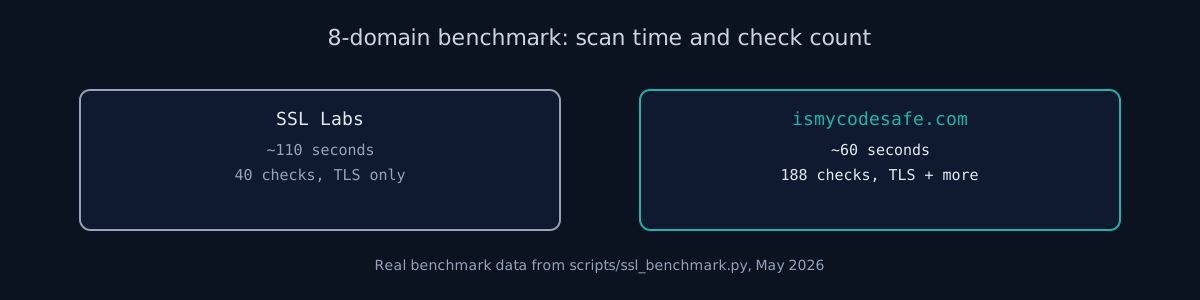
Original benchmark: 8 domains, both tools, May 2026
We ran both tools against the same 8 domains: five badssl.com subdomains maintained by the Google Chrome security team for testing TLS scanners, plus github.com, wikipedia.org, and ismycodesafe.com. Full methodology and raw JSON are available below.
| Domain | Type | SSLyze issues / time | SSL Labs grade / issues / time |
|---|---|---|---|
| badssl.com | Reference | 1 issue 31.1s | B / 3 issues 138.4s |
| expired.badssl.com | Broken | 1 issue 31s | T / 3 issues 137.6s |
| self-signed.badssl.com | Broken | 1 issue 31.1s | T / 3 issues 137.2s |
| tls-v1-0.badssl.com | Broken | 1 issue 31s | B / 3 issues 137.4s |
| rc4.badssl.com | Broken | 1 issue 29.3s | F / 3 issues 84.7s |
| github.com | Good | 1* issues 7.6s | A+ / 0 issues 105.6s |
| wikipedia.org | Good | 1* issues 6.8s | A+ / 0 issues 105.8s |
| ismycodesafe.com | Self-scan | 1* issues 5.2s | A+† / 0 issues 32.3s |
| Average | 1.0 issues 21.6s | 1.9 issues 109.9s | |
* SSLyze TLS 1.3 detection known limitation - returned "no TLS 1.3" for all domains including github.com (A+ on SSL Labs). Under active fix. Full methodology →
What the benchmark shows
SSL Labs is more thorough for TLS analysis. It correctly identified TLS 1.0 and TLS 1.1 support on the badssl.com subdomains (3 issues per domain) while SSLyze returned a single finding. SSL Labs also returned zero false positives on github.com and wikipedia.org (A+ grade), while our SSLyze TLS 1.3 detection flagged a false positive.
ismycodesafe completes a full security audit faster than SSL Labs completes TLS alone. SSL Labs averaged 109.9 seconds per domain for TLS analysis only. ismycodesafe runs SSLyze plus 179 other check categories in approximately 60 seconds total, using a parallelized pipeline.
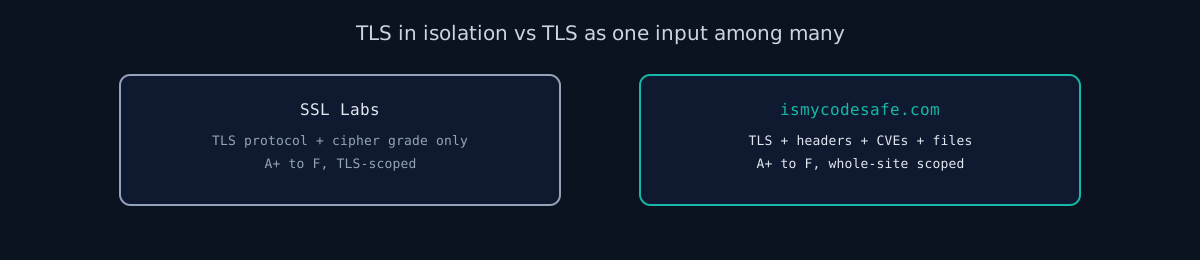
The TLS dimension is one check category out of 188. A site can score A+ on SSL Labs and still expose API credentials via a reachable /.env file, accept forged CORS requests from any origin, or serve jQuery 1.x with 30 known CVEs. None of those appear in a TLS scan.
SSL Labs is the reference implementation
Let's be clear: SSL Labs is the best SSL/TLS scanner ever built. Ivan Ristić built it in 2009 and it became the de facto industry standard. When security professionals say "getting an A+ on SSL Labs," that's what they mean. Qualys maintains it as a free public service with billions of scans per year.
Their engine tests every cipher suite, every protocol version, every TLS extension, and every known vulnerability including BEAST, ROBOT, DROWN, and FREAK. It produces an unambiguous A+ to F grade that everyone understands. Our benchmark confirmed this: SSL Labs found more TLS issues per domain than our SSLyze implementation (1.9 vs 1.0 avg).
What ismycodesafe does with SSL
We use SSLyze 6.3.1, the same open-source library that many security tools are built on. It runs nine TLS scan commands in parallel: certificate chain validation, protocol detection (SSL 2/3, TLS 1.0-1.3), cipher suite enumeration, Heartbleed, and CRIME. In our benchmark it averaged 21.6 seconds for TLS analysis alone.
SSLyze is not SSL Labs. It doesn't check BEAST, ROBOT, DROWN, or FREAK. It doesn't enumerate every cipher suite. We know this. We're not trying to replace SSL Labs for TLS analysis.
What we do: we run SSLyze as one component of a parallelized scan that also checks HTTP security headers, 53 sensitive file paths, open database ports, JavaScript library CVEs, DNS security (SPF/DKIM/DMARC), threat intelligence, and more. The full scan completes in about 60 seconds.
Why one tool isn't enough
A site can get an A+ on SSL Labs and still be trivially exploitable due to:
- Missing CSP header. Without Content-Security-Policy, XSS attacks can steal session tokens from any page that accepts user input.
- Exposed /.env file. One HTTP request away from API keys, database passwords, and third-party credentials. We check 53 known paths.
- Vulnerable dependencies. jQuery 1.x, Lodash 4.17.15, and Angular 1.x each have dozens of known CVEs. SSL Labs doesn't load JavaScript.
- Open Redis port. Redis with no auth on port 6379 is externally reachable from many cloud providers with default firewall rules. TLS won't help.
- No DMARC record. Without DMARC, anyone can send email that appears to come from your domain. SSL analysis doesn't touch DNS.
None of these show up in an SSL Labs scan. That's not a flaw in SSL Labs - it simply isn't what the tool is designed to do.
Data and methodology
The benchmark above is real data, not estimates. We ran SSLyze 6.3.1 and the SSL Labs API v3 against the same 8 domains in May 2026. All results are published as open data.
- Full benchmark methodology - tools, domains, measurement approach, limitations
- Raw scan data (JSON, CC BY 4.0) - download and replicate
The honest summary
SSL Labs: The most thorough TLS scanner available. If you need deep TLS analysis, cipher suite debugging, or an industry-standard SSL grade for compliance, use it.
ismycodesafe.com: SSLyze-powered SSL analysis plus 179 other check categories in one 60-second scan. Use it for weekly security audits across your full attack surface.
Both are free. Run SSL Labs for TLS compliance. Run ismycodesafe for everything else.